

Introduction to Transposition
Primary Chords in the Key of D Major
Songs may be played and sung in more than one key. We will now learn how to transpose the key of a piece of music. This skill is often used to place a song into a more comfortable key for singing.
Scales
Let's examine the G major and D major scales and triads. Each scale has the same quality, using identical patterns of whole steps and half steps.
Follow the notes and intervals below as you listen to the G major scale.

Now follow the notes and intervals as you listen to the D major scale.

Melodies
Now look at the melody of "Amazing Grace" in each key.
Key of G
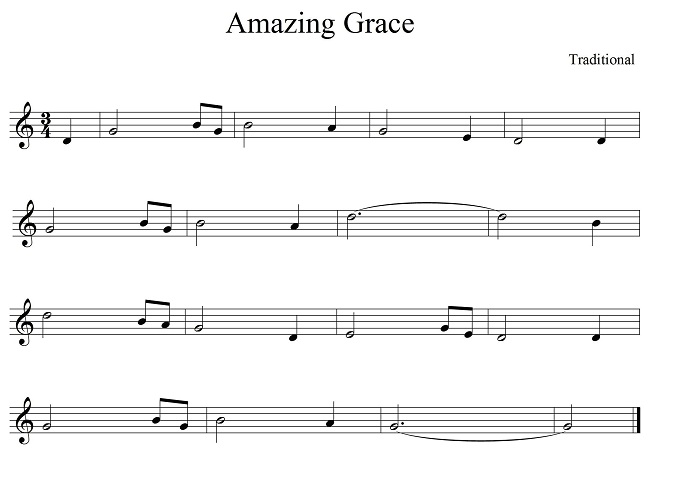
Select the icon to listen to "Amazing Grace" in the key of G major.
Key of D
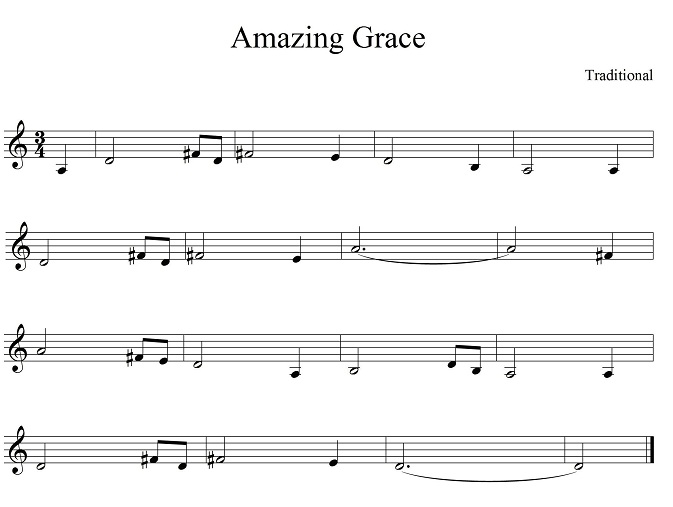
Select the icon to listen to "Amazing Grace" in the key of D major.
Chords
Here are the primary chords in the keys of G major and D major. Notice that the quality of the primary chords (I, IV, and V7) is the same for each key.
| Key | I (tonic) | IV (subdominant) | V7 (dominant) |
|---|---|---|---|
| G major | G | C | D7 |
| D major | D | G | A7 |
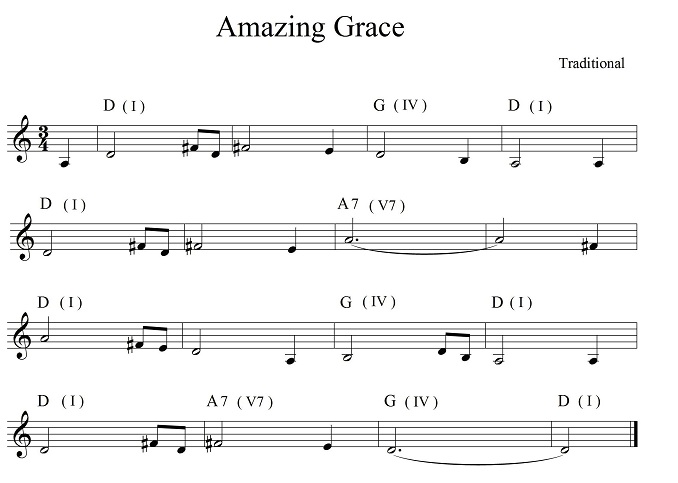
We can use the above chart to transpose the chords for "Amazing Grace" from the key of G major to the key of D major. The following arrangements of "Amazing Grace" include the Roman numerals in addition to the chord names. Although the chords are different for each key, the Roman numerals (or chord functions) remain the same.
Key of G
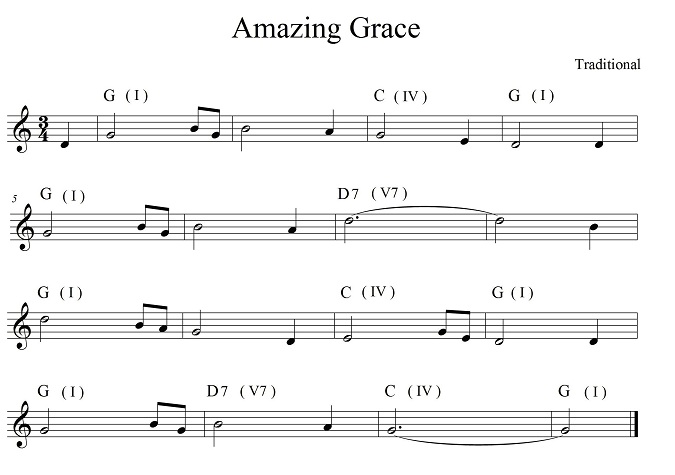
Key of D